
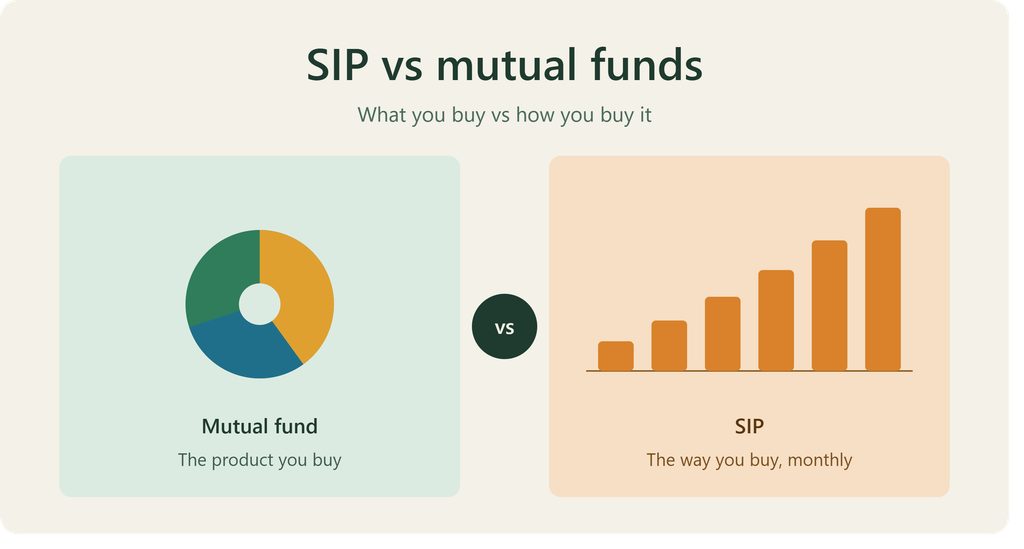
SIP vs Mutual Funds: A cousin of mine had once asked me, in all seriousness, if he should ‘do a SIP or just buy a mutual fund’. I sympathized with his dilemma. We are all so used to seeing these two words bandied about in every bank’s advertisement and financial influencer’s video, as if they were diametrically opposed products
They are not. A cursory two minute elucidation on the subject will free you from being tied up between the two.
What is a mutual fund?
Imagine thousands of people pooling in money into one pot and a fund manager investing the corpus in a variety of shares, bonds, gold, etc. The investors would receive a certain number of units in return and the value of these units would be known as the Net Asset Value (NAV). The NAV tends to increase as the value of the stocks, bonds, etc in the fund increase. Similarly, it decreases when the latter decreases.
Some common types of funds are:
- Equity Funds: Mostly stocks. While the returns are higher, the prices can also take a beating
- Debt Funds: Consists of debt instruments and bonds. Relatively safer and with smaller returns
- Hybrid Funds: A mixture of the two in varying proportions
- Index Funds: These replicate an index like the Nifty 50, and are cost-effective
- ELSS: Equity Linked Savings Scheme. Has a 3 year lock in period and provides tax benefits under section 80C for the old tax regime

What is a SIP?
A SIP or a Systematic Investment Plan is a plan. You cannot really own a SIP. A SIP is a standing instruction to your bank to electronically transfer a certain amount of money to a fund of your choice every month. A lot of schemes offer SIPs starting with as low as ₹500 (roughly the price of two meals at McDonalds). A SIP is ideal for someone who is averse to the idea of going to an ATM or the bank.
The difference explained
In short, a mutual fund is a product; a SIP is a plan. To put it in perspective, think of it as purchasing a phone. You can either pay the entire amount at once or go for an EMI. The product remains the same, the difference is in the method employed at the time of purchase. In order to compare SIP vs mutual funds, you would actually have to perform a SIP vs lump sum analysis.
What is the difference between a SIP and a mutual fund? A comprehensive list
- The mutual fund is a product. A SIP is a method of investing in it.
- A SIP cannot be created without a mutual fund. A fund, on the other hand can exist sans a SIP
- With a lump sum, you need a large chunk of money at once. A SIP allows you to invest smaller amounts of money
- With a SIP, you do not have to actively remember to invest. The periodic debits from your bank account take care of it
- A SIP allows you to dollar cost average (invest fixed amounts at regular intervals irrespective of the price of the underlying asset). A lump sum does not allow that
An example to illustrate the above bullet point
Let us assume that you have invested ₹ 5,000 every month in an equity fund. Every month, this money is being used to purchase units of the fund. When the market is performing well, the fund will give you lesser units and when it is performing poorly, the number of units would be higher. Over time, this method of averaging out the price is actually beneficial to the investor. This feature, peculiar to SIPs is known as rupee cost averaging.
Let us now assume that you continue to invest ₹5,000 for 15 years (9,00,000) in this fund. Let us also assume that the fund provided 12% returns a year (on an annualized basis). The money that you have invested would grow to roughly ₹25,00,000 (this is obviously a hypothetical example). Obviously, the market cannot provide consistent returns for 12 long years, and you will also encounter years of losses. The trend of the market is upwardly sloping though and a SIP ensures that your average returns will exceed the average returns from a lump sum.

Why salaried people tend to prefer SIPs
Someone who is salaried and whose income comes once a month will appreciate a SIP. Some people prefer SIPs because
- They can begin with small amounts and increase the amount every year
- The money is withdrawn before discretionary expenses can eat into it
- They do not have to worry about timing the market
- Most SIPs can be paused or modified without penalties
- The compounding effect will take longer to kick in if the money is invested as a lump sum
One popular example of a systematic investment plan is the step up SIP, wherein the amount invested increases by a predetermined amount every year. For instance, you can increase the amount invested by 10% every year (this will also reflect in salary increases if you are employed). These increases negate the inflationary effect of the increased standard of living and allow you to accumulate a significantly larger corpus after 20 years.
When lump sum investment makes more sense
Sometimes, one has a large amount of money lying idle. For instance, one might receive a bonus or a maturity benefit from a life insurance policy. It may not seem feasible to invest the entire amount at once and wait for two years for the SIP to finish. Here is where a lump sum can be particularly useful.
Some reasons why a lump sum might make more sense than a SIP:
- The entire amount is invested
- There is only one transaction
- If the market is on a consistent rise since the time of the investment, a lump sum can prove more beneficial
- There is no risk of having to stop a SIP due to a market crash (this could be detrimental if the SIP was supposed to run for a longer period of time)
A good middle ground in this case would be to park this corpus in a liquid or debt fund and transfer it systematically to an equity or hybrid fund (a systematic transfer plan or STP).
The risks involved with a SIP
It goes without saying that a SIP is not an assured income. A SIP will have all the risk associated with the fund in which it is invested. Some things to remember when considering a SIP are:
- Equity funds can fall by as much as 20%
- The fund that delivered exceptional returns last year may not do so this year
- The most prudent time to stop a SIP is during a market crash (but this would mean selling the fund at a loss)
- Choosing the wrong fund can do more damage than choosing the wrong SIP
For equity funds, a five year time horizon is recommended. Similarly, anything shorter than this should be invested in a hybrid or a debt fund.
Does a SIP have an impact on the tax?
Taxability depends on the fund and the period of holding. However, a SIP is not treated differently from a lump sum. One thing to consider is that every monthly instalment qualifies as a separate purchase and is taxed according to its period of holding
The rules governing taxation tend to change often, so it is best to keep an eye on the notifications from the income tax department or consult a chartered accountant.
Which option is better?
The choice depends on your income pattern and your tolerance for volatility. You can go for a SIP if
- You are salaried
- You have just begun your journey into investing
- You find yourself losing sleep over the idea of a market crash
You can go for a lump sum if
- You have some extra money lying around that is not required for an emergency
- You are mature enough to assess that the market is not in a bubble
- You have the mental fortitude to withstand a market crash
Ideally, you should pursue both options. Have a SIP as your primary source of investment and invest lump sums in the fund whenever you have the extra money.
Whatever you choose, remember to give the money a role to play. ₹ 2,00,000 earmarked for a house down payment in three years cannot wait for retirement in twenty five years.
Common SIP mistakes that you should avoid
- Cancel your SIP immediately after a dip in the market
- Buy the same fund that delivered the best returns last year
- Having six or seven SIPs all invested in funds consisting of the same stocks
- Overlooking the expense ratio of the fund (this can have a deleterious effect over time)
- Not setting a target amount or a time frame
It is not necessary to review the SIP every morning. Once or twice a year is enough.
Some frequently asked questions
Is SIP better than a mutual fund?
A SIP is actually a method of investing in a fund. Therefore, comparing the two would be similar to comparing an EMI to a phone.
Can I invest in a mutual fund without a SIP?
Yes. You can invest in a fund through a lump sum on a daily basis.
Is a SIP safe?
A SIP is a systematic method of investing in a fund. Therefore, it will have all the risks associated with the fund. Debt funds tend to be safer than equity funds
What is the minimum SIP amount?
This varies between different mutual fund companies. However, ₹ 500 is a good amount to begin with.
Can I stop a SIP anytime?
Yes, usually, there are no penalties. However, ELSS funds do not allow this as each instalment has a lock in period of three years.
Conclusion
Once you understand the interplay between these two, the SIP vs mutual funds debate becomes academic. The fund is where your money goes. A SIP is a method of getting it there. And for most people who are salaried, it is probably the easiest method available. Pick a fund that suits your requirement and let the machine do the work for you. That last statement refers to not meddling with the SIP once it has been initiated.