
Unexpected expenses have a way of coming when you least expect them. A medical bill, layoff, home repair, or car repair can wreak havoc on your finances if you have no savings to fall back on.
That is what an emergency fund can help with. Having an emergency fund can help put you in a better position to survive a financial emergency without immediately relying on credit cards, loans, or other high-interest debt.
But how are you supposed to build an emergency fund from 0? Surely reaching a target of 1,00000 seems intimidating at first, but there are some ways to help you through this.
What is an emergency fund?
An emergency fund is a stash of cash saved for a financial emergency. It should be money that is set aside to cover essential expenses only and not for splurging on gadgets, vacation, etc.
What can come under an emergency fund?
- Sudden medical expenses
- Job loss
- Vehicle repair
- Home repair
- Family expenses
- Emergency travel
- Appliance replacement
- Any other unavoidable expense
The money saved as an emergency fund must be easily accessible as we do not have the time to wait for it to mature.
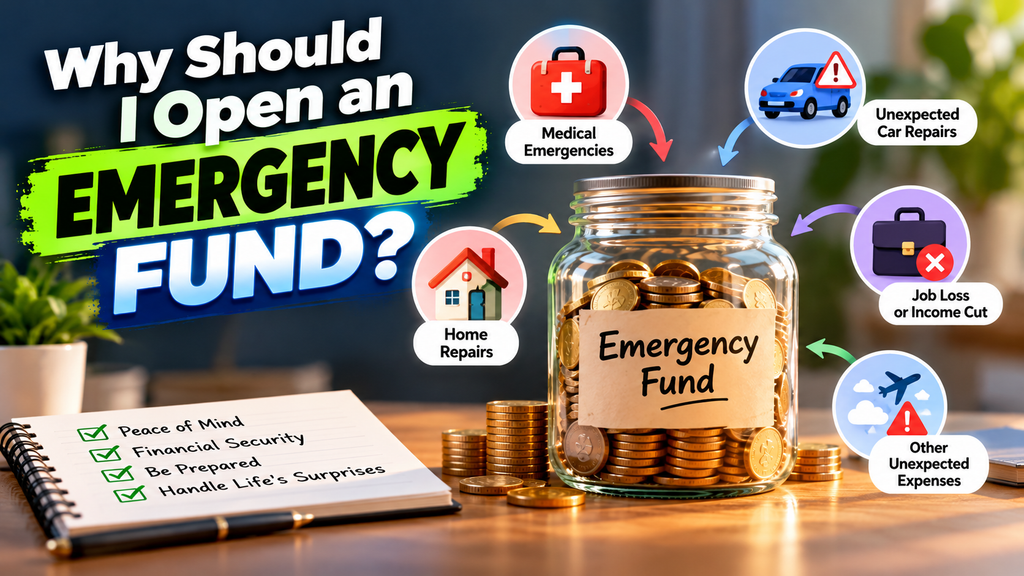
Why should I open an emergency fund?
Without an emergency fund or any savings, any random expense that comes our way can leave us with having to make terrible financial decisions.
Suppose your car breaks down and it needs a 20,000 repair. If you do not have any emergency fund, you will either have to pay it off with your credit card or take a loan.
But the 20,000 repair would now become 25,000 due to the interest. An emergency fund can help you avoid such financial stress, give you breathing room and freedom of choice in a financial crisis.
Some of the advantages of an emergency fund are:
- Stress-free savings
- Save you from using your monthly budget
- Save you from debts and interests
- Prevent you from making rash decisions
- Freedom of choice
- Peace of mind
- Helps you set realistic goals
It is not about getting rich quick; it is about getting safe.
Is 1 Lakh a good emergency fund?
1 Lakh is a good target to reach for, but for most of us, it may not be enough for a proper emergency fund.
The amount of money needed for an emergency fund varies from person to person. For someone for whom 40,000 is essential expenses, 1 Lakh may be a good emergency fund.
But for someone for whom 60,000 is their monthly essential expenses, 1 Lakh may not be enough.
In order to determine your emergency fund, you must calculate your monthly essential expenses, your monthly income and then decide how much you can save on a monthly basis considering your monthly expenses.
You may also want to think about your monthly debt payment, family, lifestyle, and so on.
Once you reach 2-3 monthly expenses, you would have a good emergency fund.
The target of 1 Lakh is a good target for a beginner to set their eyes on in order to develop the saving habit. Once you are done with 1 Lakh, you can slowly move towards setting your target at multiple monthly expenses.
Steps to make an emergency fund
Step 1: Think about ₹0 emergency fund with ease
Forget about how much money you currently have in your emergency fund. Focus on getting to 1,000 first and then 5,000, then 10,000 and so on till you reach 100,0000.
It does not matter much if today I save 50 or if today I save 500. The first target is to show yourself that you can stick to saving.
Step 2: Calculate your monthly income
Calculate your monthly income. It must be an approximate figure. If your income varies from month to month, use the lowest figure as your monthly income.
Step 3: Track your expenses
You cannot save money if you do not know where your money goes. Track your expenses for a month.
You will know which expense is eating up a lot of your money. Categorize your expenses. You can use your net banking transaction history or your UPI transaction history or your credit card statement and so on.
Once you sort out your expenses, take a look at what all you can cut down on. You can cut down on just 50-100 from each category. It will slowly start adding up.
Step 4: Set a target for your monthly savings
Now set a target for your monthly savings.
For example:
| Monthly Saving | Time to Reach ₹1 Lakh |
|---|---|
| ₹1,000 | 100 months |
| ₹2,500 | 40 months |
| ₹5,000 | 20 months |
| ₹7,500 | About 14 months |
| ₹10,000 | 10 months |
| ₹12,500 | 8 months |
| ₹15,000 | About 7 months |
| ₹20,000 | 5 months |
This does not take into account any profits earned from the money saved.
Step 5: Let your money work for you
Let your money work for you. The best way to do this is by automating your savings.
Instead of waiting for the end of the month to save some money, immediately after you receive your income, save around 5,000 in a separate account.
It will keep you from spending the money that you were supposed to save.
You can think of your emergency savings as your monthly dues.
Step 6: Open an emergency savings account
Do not keep your emergency fund in your savings account. It is best to keep it separate from your everyday transaction account so that it does not become a temptation to use the money in your emergency fund for everyday expenses.
The emergency savings account should be:
- Easy to access
- Safe
- Should not be mixed with your daily expenses
- Should be liquid or should be able to be withdrawn anytime
The most important thing is to keep your emergency fund safe and accessible in case of an emergency.
Step 7: Cut down on unnecessary expenses
You do not need to change your entire lifestyle in order to save 1 Lakh. Try and cut down on unnecessary expenses.
Instead of looking for what all you can change in your lifestyle, look for those expenses that do not give you value for money.
For example:
- Subscriptions that you do not use
- Spending too much on food delivery
- Going on shopping sprees
- Making unnecessary online purchases
- Expensive subscriptions
- Going on vacations often
- Unnecessary charges
If you cut down on these and instead put the money into your emergency fund, you will surprise yourself with the amount of money that you will be able to save.
Step 8: Use your extra income
You can also use your extra income to save money for your emergency fund.
Whenever you get extra money, channel it into your emergency fund. Some of the ways in which you can get extra money are:
- Extra freelancing projects
- Bonuses
- Cashback
- Selling your old stuff
- Side gigs
- Business income
If you get an extra 10,000 and you have already met your monthly expenses, you can put the entire amount into your emergency fund.
Step 9: Try a 30-day no-spend challenge
A 30-day no-spend challenge is a good way to assess how much money you are spending unnecessarily.
You do not have to stop paying your bills, but you must try and stop spending your hard-earned money on useless things.
For example, during this period, you can stop:
- Going to restaurants
- Making unnecessary online purchases
- Going on shopping sprees
- Wasting money on clothes that you do not need
- Wasting money on coffee or tea
- Cutting down some subscriptions
At the end of the month, you can add the amount of money that you were able to save in this period to your emergency fund.
Even if you do not continue this challenge for a long time, you are likely to notice a few things that you could cut down on.
Step 10: Try to save your first ₹10,000
Your first target to reach should be 10,000.
Instead of trying to think about how you can save 1 Lakh, think about how you can reach 10,000.
You can reach 10,000 by:
- Saving 2,000 for 5 months
- Saving 5,000 for 2 months
- Or simply saving 10,000 in 1 month
- Or saving 5,000 for a month and adding the extra income to it
- Or any other way
Once you reach 10,000, it will be easier to imagine how you can reach 1 Lakh.
Step 11: Work to move from ₹10,000 to 50,000
Once you have reached your first target of 10,000, continue working towards your next target.
For example, saving 5,000 each month, will get you to 50,000 in 8 months (excluding the interest). But during these 8 months, do not touch the money that you saved in the first 10,000.
The money in your emergency fund should have a purpose.
And if an expense comes, the first thing that should come to your mind must be:
- Is this an emergency?
- Will this expense be difficult to bear?
- Can this be paid off from my salary?
If the answer to all these questions is yes, only then you should use your emergency fund.
Step 12: Try to get to ₹1 Lakh
Once your emergency savings reach 1 Lakh, do not stop there. Have a good long look at your financial status. Think about:
- Your monthly essential expenses
- Job profile
- Debts
- Family members
- Insurance
- Financial goals
For some of you, 1 Lakh may be enough for a few months’ expenses while for some of you, it may not be enough.
Think of 1 Lakh as a stepping stone on your way to building a large emergency fund.
What should I not use my emergency fund for?
Your emergency fund should primarily be used for unavoidable and essential expenses.
Do not use your emergency fund for:
- Smartphones and gadgets
- Vacations
- Restaurants
- Shopping
- Entertainment
- Planned purchases
- Lifestyle changes
- Impulse buying
If you begin to use your emergency fund for unplanned and non-essential expenses, it will become difficult to save money. It is best to open separate savings accounts for different purchases.
Where should I keep my emergency fund?
Your emergency fund should primarily be saved in a safe and easily accessible place. It should not be invested in something where its value might depreciate quickly when you need it the most.
Depending on your lifestyle and financial needs, you may choose to invest your emergency fund in separate financial instruments. You may divide your emergency fund according to your needs, risk appetite, etc.
But remember that you must not invest the entire amount in something where the value may depreciate. A separate bank account, a safe, or a good bank deposit can all be suitable options for storing your emergency fund, depending on your lifestyle.
How can I stay motivated while saving up my ₹1 Lakh?
It can be frustrating to save money when money seems to come out faster than it goes in. In such situations, it helps to visualize your progress.
Make a chart where you can see yourself crossing various milestones:
From ₹0 to ₹10K to ₹25K to ₹50K to ₹75K to ₹1L
You can make a table or a spreadsheet or simply use a pen and paper to track your progress.
Celebrate your achievements, but do not celebrate with the money that you worked hard to save. The best way to celebrate is by being proud of the fact that you were able to achieve something great.
What if I am in debt?
If you are in debt, it is best to first clear your debt before you start saving money for your emergency fund. But it is also important to have at least a small emergency fund in case of any unavoidable expense so that you do not have to bear the burden of paying it off with your credit card.
After you have set a small emergency fund, you can start looking into the terms of your debt and slowly start paying it off.
Your financial goals may change depending on your situation and lifestyle.
Some people may have to pay their monthly debts first, some may want to pay back their expensive debts first and some may want to increase their emergency fund before doing anything else.
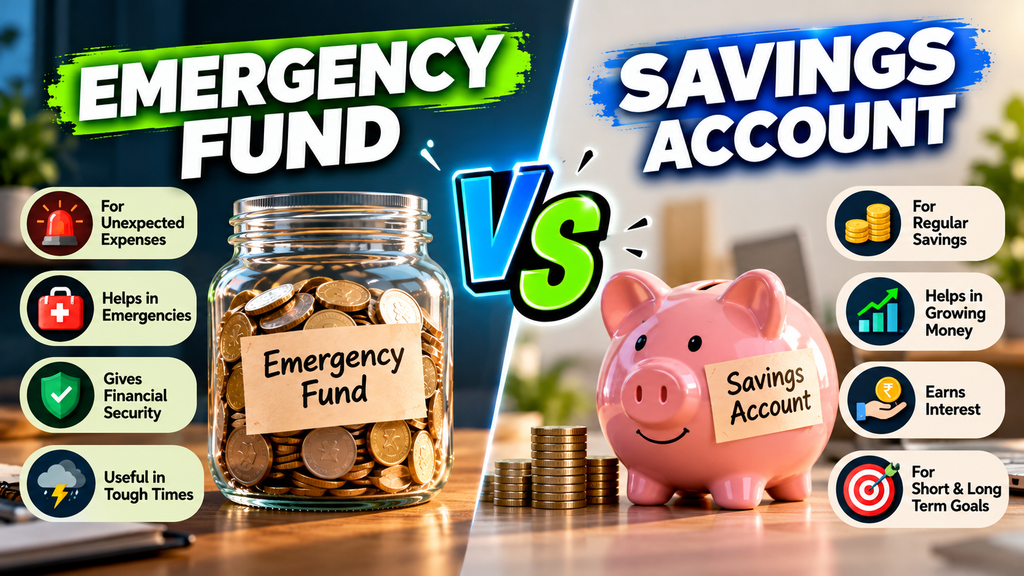
Emergency fund vs. savings account
An emergency fund and a savings account are two very different things. Even though the words savings account and emergency fund are used interchangeably, their purposes are very different.
A savings account is for goals or things that you want. On the other hand, an emergency account, as its name suggests, is for emergencies.
It is important to not confuse the two and keep the goals separate. This way it will be easier to reach your goals and avoid putting your emergency fund into unnecessary expenses.
For example, in order to save money for your vacation, you can set a separate savings account. Instead of putting money in your emergency fund, you can put it in your vacation savings account.
Similarly, you can have a separate savings account for gadgets and a separate investment account for your long-term financial goals.
Final thoughts
Saving money for an emergency fund may seem like a daunting task when you start, but patience and planning can help you achieve your goals. Focus on small targets instead of worrying about the large target that you want to achieve in the long run.
Track your expenses and savings. Automate your savings. Cut down on unnecessary expenses. And above all, use your extra income wisely.
Remember that you may not see drastic results every month, but every little bit adds up over a period of time.
Once you reach your target of 1 Lakh, you should have a good look at your financial status and determine whether or not you want to continue increasing your emergency fund. It is important to keep building your emergency fund so that you always have a little something for emergencies.
Start with 1,000. Then 5,000. Then 10,000. And so on till you reach 1 Lakh.